EN
 Italiano
 Français
 Deutsch
 Polski
 Nederlands
 Español
 日本語
 Čeština
 简体中文
 Русский
 Português
 한국어
 Magyar
 Norsk
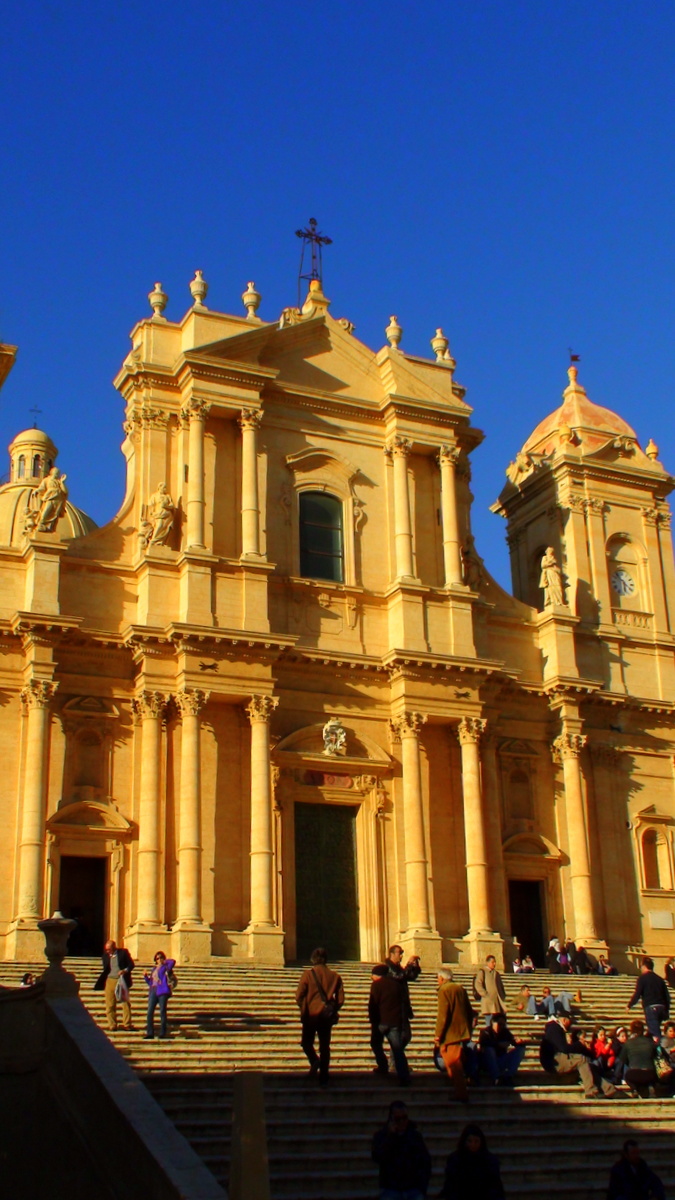
Sicilian Baroque is encountered in facades, in squares, in interiors, and in the way a street sets up the view of a building. Between the seventeenth and eighteenth centuries the island became a great architectural laboratory, especially after the transformations that followed the earthquake of 1693. In the eastern part of Sicily, which was particularly hard hit, reconstruction opened up the possibility of rethinking entire urban sequences. This is an essential fact for understanding why the Baroque cannot be reduced to a richly decorated church. In many places the power of the experience arises from the relationship among several buildings and from the common space that connects them.
The 1693 earthquake and Modica
In the southeast the earthquake of 1693 made extensive rebuilding necessary, but Sicilian Baroque is not limited to the cities that were struck. In Modica the church of San Giorgio organizes a scenographic vision along the urban route; in Noto Palazzo Villadorata shows how the same taste pervaded aristocratic residences; in Syracuse the Baroque facade of the cathedral clothes a building of much older history. Other examples are found in Caltanissetta, Leonforte, and Marsala. Keeping them distinct prevents attributing every Baroque work to the same earthquake. Some were born of reconstruction, others from the initiatives of religious or noble patrons in territories not destroyed in 1693. The language could serve a church, a palace, or a civic space, with different effects on the city.
The church of San Giorgio in Modica allows us to reflect on the role of position and route. A great facade acquires scenic value when it presents itself along the itinerary of those who arrive and move through the surrounding space. In Noto, Palazzo Villadorata invites us to look at how civic architecture participates in the same visual culture as the churches. In Syracuse, the facade of the cathedral reminds us that many monuments have a history longer than their Baroque dress. Reading these places therefore requires two gazes at once: one directed at the composition that appears today, the other at the structures or functions that may precede it. This prevents flattening centuries of history onto a single stylistic moment.
Vaccarini and the other architects
Among the architects, Giovanni Battista Vaccarini stands out, linked to the reconstruction of numerous monuments in Catania, as well as the Collegio Cutelli and the church of Sant'Agata. The cathedral of Catania also belongs to this trajectory. Following an architect's works within a city helps us understand how a language can take different forms according to the program. A building intended for education, a church, and a cathedral converse with different parts of urban life. The author leaves a trace, but the result also depends on the place and the needs the construction had to answer. This is why an itinerary in Catania can be read as a series of relationships, not as a catalogue of facades.
In this season Giacomo Amato also worked in Palermo, Giovanni Vermexio and Andrea Palma in the Syracuse area, Guarino Guarini and Filippo Juvarra in relation to Messina. It is a constellation of names that shows the plurality of the Baroque season. Their works cannot be reduced to a shared decorative trait: what counts is the design of the whole, the way movement is guided, and the ability to give prominence to a point in the city. Juvarra later brought his own language to the Savoy court. His career reminds us that artists were not confined to the island; their works and their ideas participated in a broader circulation.
Serpotta’s stuccoes
Interiors also deserve attention. Giacomo Serpotta and his family occupy an important place in stucco decoration. Among the places to observe are the Palermo oratories of the Rosario in Santa Zita and of San Lorenzo, along with other religious commissions. Stucco changes the way a wall is perceived: it creates figures and reliefs that converse with the light and with the path of those who enter. To observe it as mere ornament means losing the construction of a narrative and of an environment. In the oratories the visitor can seek the relationship between individual scenes, frames, and architecture, letting the eye pass from detail to the whole.
The villas of Bagheria
Sicilian Baroque also encompasses the architecture of villas. In Bagheria, Villa Butera, Villa Valguarnera, and Villa Palagonia are examples linked to the patronage of the Palermo nobility. Here the discourse shifts from the compact city to residences designed to represent rank and taste in another context. Comparison with a church in Noto or an oratory in Palermo brings out the flexibility of the Baroque language. There is no single scale: theatricality can involve a square, a room, a garden, or the profile of a residence. Here too we must consider that buildings have changed over time and that a photograph shows only one phase of their story.
The reconstruction of the eastern cities, the oratories decorated by Serpotta in Palermo, and the villas of Bagheria belong to different contexts, but they show the same attention to the effect of the whole. In Modica what counts is the approach to the facade; in the oratories the stucco narrative unfolds on the walls and accompanies those who enter; in the villas the design also involves the relationship between residence and garden. Sicilian Baroque emerges from these spatial choices, as well as from the richness of detail. The earthquake of 1693 was a turning point for many cities, not the sole cause of every work. Observing for each monument who commissioned it, what use it was to have, and how it fitted into the urban fabric restores a more precise history than the simple stylistic label.
Photo: Ainars Brūvelis · CC BY-SA 3.0 · Wikimedia Commons