EN
 Italiano
 Français
 Deutsch
 Polski
 Nederlands
 Español
 日本語
 Čeština
 简体中文
 Русский
 Português
 한국어
 Magyar
 Norsk
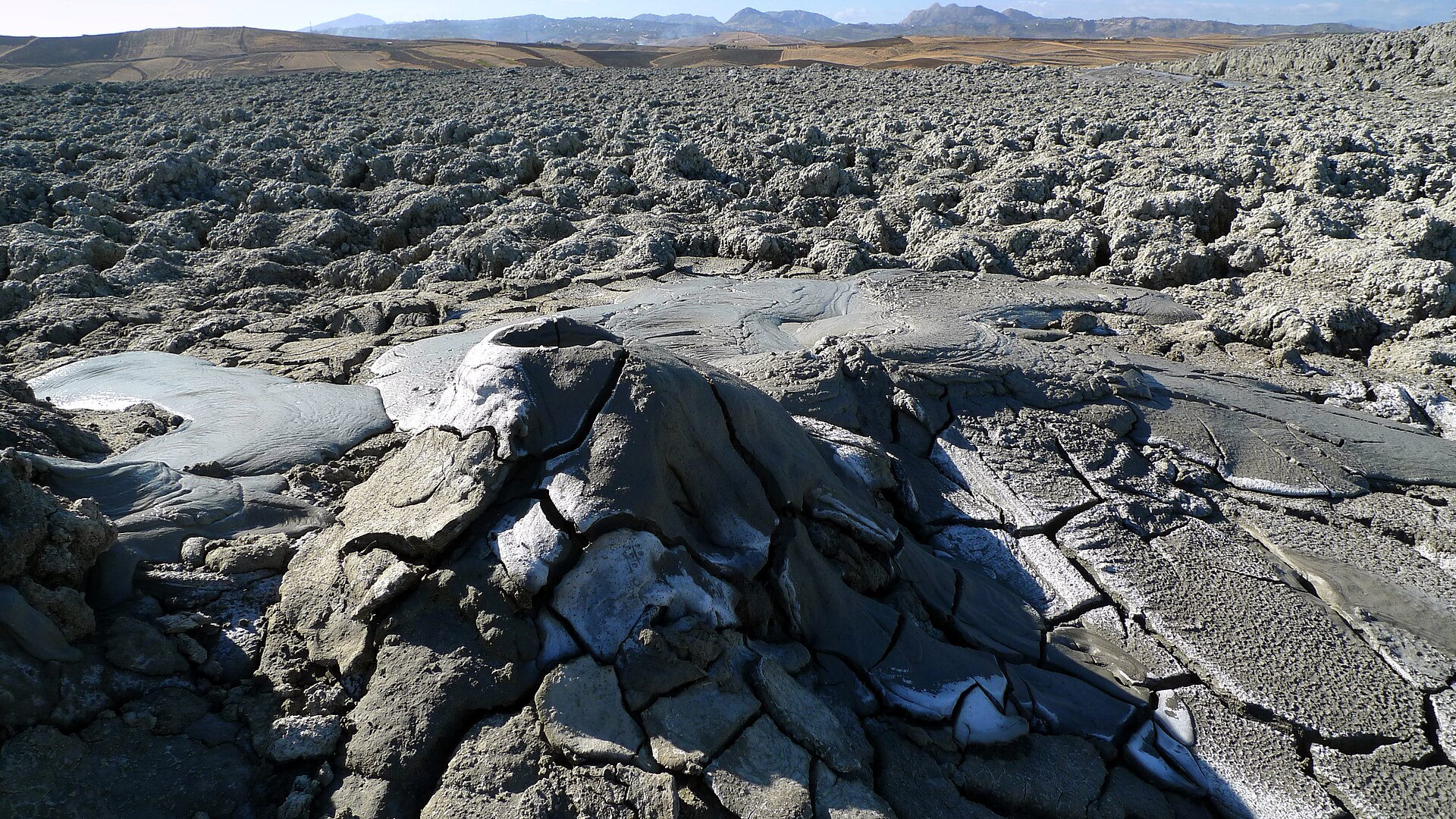
In the territory of Aragona, north of Agrigento, the Macalube display a geological phenomenon that can surprise anyone who associates the word volcano only with lava and fire. Here the landscape is made of clay hills, small mud cones, and surfaces that change with humidity. The area lies about fifteen kilometers from the city of Agrigento; the hill of the Vulcanelli is the visible center of this activity. The first impression may be of an almost bare terrain, with pale and grayish tones. Looking more closely, however, one discovers a system in motion, in which gas, water, and sediments find pathways to the surface and slowly modify the shapes of the ground.
Sedimentary volcanism
The term sedimentary volcanism helps explain the difference from a magmatic volcano. Beneath the ground, gases — especially methane — exert pressure on water and fine materials. The mixture can rise through layers of unconsolidated clay and emerge, forming small conical edifices. The little volcanoes observed on the hill generally reach modest dimensions, often around one meter, but their interest does not depend on height. Each cone reveals an underground pathway, a point where mud reached the surface, settled, and built up a rim. When the material dries, its consistency and color change; new emissions can reshape it.
The appearance of the area does not remain the same throughout the year. Wet clays become plastic and mark the ground with flows and small swellings; with heat and evaporation, crusts and cracks may appear. Rain also shapes the slopes, carving furrows and gullies. For this reason, the landscape of the Macalube can be read as the result of several processes acting together. The mud emerging from the subsurface attracts attention, but rainwater and erosion help create the texture of the surrounding hills. Observing the forms from safe points makes it possible to distinguish a recent cone from an already dry surface and a channel produced by the flow of water.
Plants and temporary pools
The geological singularity does not exclude plant life. In autumn the nearby areas take on green tones, while in spring wild blooms appear. The contrast with the barer hill is instructive: soils, salinity, humidity, and instability condition the ability of plants to take root. Where the ground settles, grasses and flowers can occupy small spaces; where emissions or erosion are more active, the cover remains discontinuous. A visitor who focuses only on the little volcanoes therefore misses part of the story. The landscape also includes edges, slopes, and transitions between apparently sterile ground and areas richer in vegetation.
In seasonal depressions, temporary pools can form. They are small collections of water linked to rainfall, which interrupt for a period the dry appearance of the clay hills. These environments offer important conditions for amphibians and reptiles: their presence completes the picture of a reserve that at first glance seems dominated only by mud. The pools form and disappear; for this reason, a visit in spring can reveal a landscape different from that of summer. Watching them from permitted paths makes it possible to notice the relationship between terrain, water, and life without altering a fragile margin. The little volcanoes are the most evident phenomenon, but the seasonal pools show that the area changes even when the emission of mud is not spectacular.
The birds
Birds add movement to the open skies of the area. Among the birds one encounters the marsh harrier and the kestrel, as well as species that may stop during migration. A bird of prey in flight uses the structure of open spaces differently from a bird seeking shelter among grasses and shrubs. Here too, actual presence varies over the course of the year and at different hours of the day. Stopping to observe without approaching sensitive points allows one to follow movements and understand how animals use a landscape that, at first glance, might seem poor. Biodiversity does not always coincide with dense vegetation: even clay soils and seasonal pools create specific opportunities.
Visiting with care
A visit to the Macalube requires particular attention to conditions and official indications. The ground can be unstable, and the phenomenon does not follow the expectations of those who arrive to see a photograph. Access points and walkable areas can change; it is essential to verify them on site and respect every restriction. The value of the experience does not consist in getting as close as possible to a cone. A suitable observation position makes it possible to read the whole: the hills, the gullies, the hill of the Vulcanelli, and the vegetation that traces their edges. Binoculars or a camera lens can help one see without interfering with a delicate system.
The small scale of the cones is what makes the Macalube particularly instructive. On a limited surface one can distinguish the point where mud rises, the deposit that builds the rim, and the cracks left by drying. All around, the gullies tell of the work of rain on the clays, while seasonal vegetation and pools add other rhythms of transformation. These are different processes, often confused in the first impression of a gray and bare landscape. Separating them with the eye helps explain why the reserve is not a miniature version of Etna: here gas, water, and sediments shape the surface, and every detail helps tell of a subsurface that is still active.
Photo: Marpolia · CC BY-SA 4.0 · Wikimedia Commons