
 EN
EN Italiano
 Français
 Deutsch
 Polski
 Nederlands
 Español
 日本語
日本語 Čeština
 简体中文
简体中文 Русский
 Português
 한국어
한국어 Magyar
 Norsk
Norsk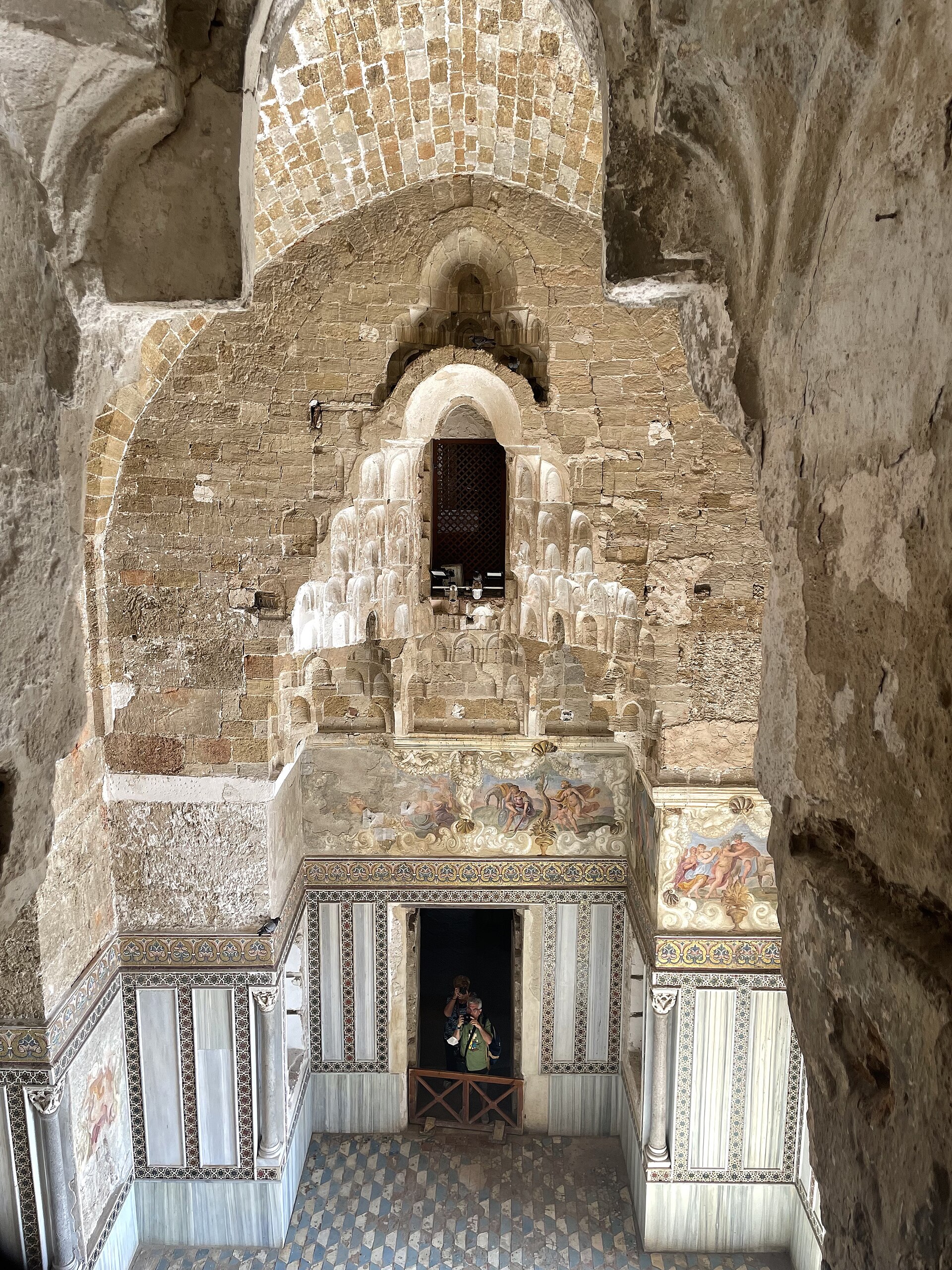
The Arab conquest of Sicily was a long process, not an event concluded in a single year. The conquest began with the landing in 827 and proceeded in different stages: Palermo fell in 831, Syracuse in 878, and Taormina in 902. This sequence helps us understand how difficult it was to control an island with fortified cities, differing territories, and already complex political relationships. Meanwhile, the centers of gravity shifted. Palermo gradually became the capital of Muslim Sicily and a great commercial hub of the Mediterranean, while Syracuse lost the political primacy it had held for so many centuries. The new phase transformed the economy, urban organization, and daily life.
Palermo, a city of many peoples
Palermo makes this transformation visible more than any other city. The city had to expand to respond to the growth of administrative functions and inhabitants. The Kalsa was built as a fortified area outside the ancient walls and served as the seat of the emir; there were also quarters linked to different social groups, including that of the Jews. These are not merely names that have survived in the city's topography. A capital needs spaces to govern, to live, to sell goods, to practice trades, and to organize the movement of people. The growth of Palermo was therefore both a material and a social fact. Even when buildings have been transformed, reading the city by quarters helps to grasp the depth of that change.
In Muslim Palermo, people of different origins lived and passed through: Arabs, Berbers, Greeks, Jews, and groups arriving from other regions of the Mediterranean and Europe. The port connected this population to external markets; in the quarters, activities, places of worship, and different ways of life were concentrated. Plurality did not mean that everyone held the same power. Those who governed the city decided the taxes and the rules of public life, and the Christian and Jewish communities were subject to particular conditions. The development of commerce must be read within this concrete society: goods and techniques circulated thanks to contacts, while the legal status of individuals remained unequal. This distinction prevents turning the city into a postcard of tolerance without conflict.
Trade and new crops
During the Arab phase, commerce and many productive activities experienced notable development. The island's central position, inserted into an extensive network between Spain and the eastern Mediterranean, made it possible to exchange products and knowledge. Innovations in fishing, weaving, silk processing, and mining expanded the island's economic possibilities. Describing these sectors avoids reducing the Arab legacy to a repertoire of domes or a few typical dishes. Behind a fabric or a good sold in the city were artisans, supplies, techniques, and maritime routes. The cultural wealth of a society is also measured by its capacity to organize work and circulate its results.
Agriculture was another area of change. The reduction of large estates, the redistribution of land, and the extension of new crops transformed the landscape and the cuisine. Among the plants cultivated or disseminated in this season were citrus fruits, apricots, pistachios, eggplants, jasmine, rice, and saffron. It is more useful to consider this ensemble as evidence of a transformation of cultivated fields and consumption than to attribute the absolute origin of every species to a single era. Cultivating a plant, in fact, requires suitable land, water, people capable of following its cycle, and markets in which to sell its products. Citrus groves and vegetable gardens thus become part of an economic history, not merely a picturesque image of Sicily.
Water, districts and coexistence
Water is at the center of that history. To raise it from wells and distribute it to the fields, various technical systems were used; wind power also operated mills. These are innovations to be read in their context: where rainfall is irregular, improving irrigation means being able to cultivate with greater continuity and vary production. An agricultural technique changes the rhythm of work, the value of land, and even the appearance of a settlement. The salt pans of the Trapani area, with the mills linked to salt processing, also remind us that the use of natural energy did not concern agriculture alone. The material legacy of that knowledge is recognized in landscapes built over time by the encounter between environmental resources and human labor.
Muslim Sicily was also organized into districts. The Val di Mazara, the Val di Noto, and the Val Demone were districts whose names continue to appear in the island's history. Dividing a territory means making its administration, tax collection, and control possible; it also means recognizing that western Sicily, the southeastern area, and the Messina region presented different characteristics. This political geography allows us to read regional differences without losing the unity of the Sicilian story. When one encounters one of these names in an itinerary or a document, one is not observing a simple geographical indication: one is encountering a trace of ancient forms of government.
The relationship between Muslims, Christians, and Jews requires attention. Non-Muslim communities preserved spaces of religious life, but were subject to taxes and restrictions. Even the presence of churches or cultural exchanges therefore does not amount to full equality. Historical coexistence could include economic collaboration and legal limitations at the same time. This is a decisive point for understanding the island without idealizing it: many of its cultural forms were born from contacts between people who did not enjoy the same rights. Linguistic and religious variety was real, as were the power relations that ran through it.
The legacy in architecture
In architecture, Arab influence continued beyond the end of political dominion. San Cataldo, San Giovanni degli Eremiti, and the Zisa in Palermo, together with the lavatoio of Cefalù, offer examples to observe in order to recognize the persistence of forms and techniques. These places belong to different construction histories and should not be presented as buildings all originating during Muslim rule. They show rather how forms, techniques, and tastes continued to circulate and be reworked, especially in the encounter with the Norman world. Arches, gardens, interior spaces, and decorations are clues to a broader language. Arab Sicily is thus understood not as a closed parenthesis, but as a phase that left tools, words, and models used by later centuries as well.
Photo: Carl Ha · CC BY-SA 4.0 · Wikimedia Commons






















.jpg)