EN
 Italiano
 Français
 Deutsch
 Polski
 Nederlands
 Español
 日本語
 Čeština
 简体中文
 Русский
 Português
 한국어
 Magyar
 Norsk
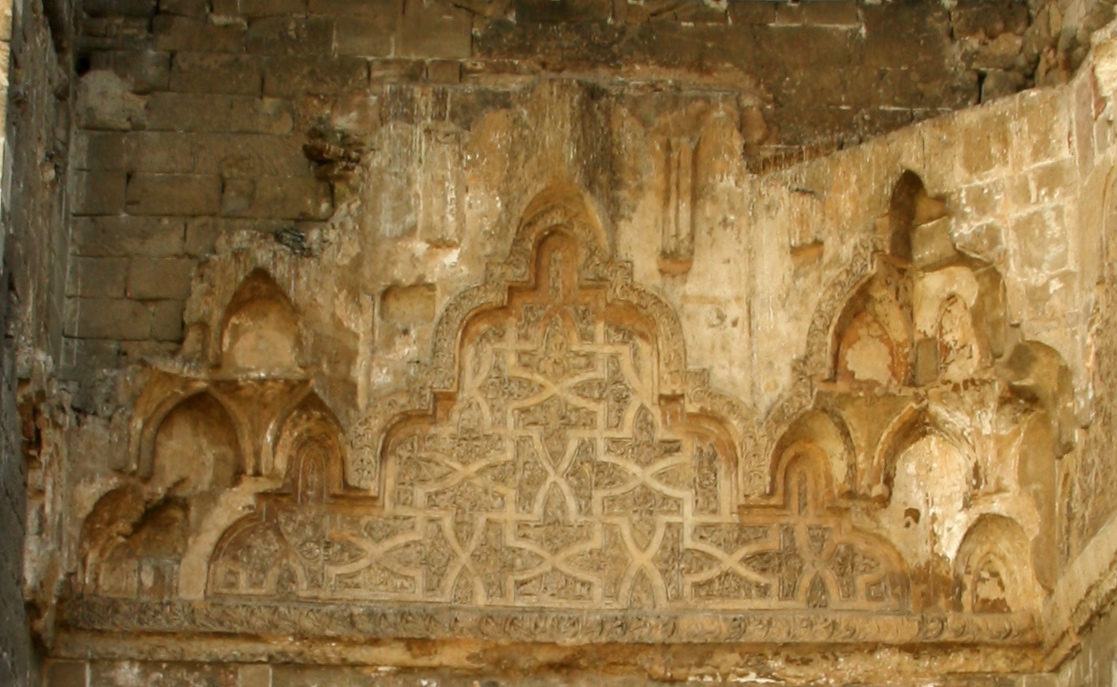
The Arab influence in Sicilian art is best seen when considering the island's entire medieval experience. The conquest of Palermo in 831 and that of Syracuse in 878 accompanied a profound cultural transformation. Palermo became a leading political and commercial center, traversed by diverse peoples and traditions. The expansion of the city, with new neighborhoods, shows that the change also concerned urban form. The Kalsa, a new fortified settlement outside the older walls, makes this development tangible. Alongside it, other neighborhoods formed around the communities that lived and worked in the city. Palermo thus shows that the encounter between cultures also had a precise spatial dimension. To speak of artistic influence, then, means going beyond a particular decorative detail: it encompasses the way of building, of inhabiting, of organizing water, and of interpreting common spaces.
The decorative techniques and forms of Eastern origin left a lasting imprint, which becomes visible through concrete examples. One building may present a compact geometry and domes that determine its profile; another may use arches and courtyards to compose the passage between interior and exterior. The materials, the surfaces, and the relationship with the garden contribute to the whole. Yet seeing an arch or a decoration is not enough to attribute the entire monument to the phase of Arab domination. Many buildings in which these forms are visible in fact belong to the Norman age, when different languages were combined by patrons and workshops active on the same island.
The churches of San Cataldo and the Eremiti
San Cataldo and San Giovanni degli Eremiti, in Palermo, are Christian churches of the Norman age in which forms linked to Islamic architectural culture can be recognized. The three domes of San Cataldo and the succession of those of San Giovanni degli Eremiti organize the external volumes in a manner very different from a traditional Western basilica. The red color by which the domes are now known belongs to their restored image and is not enough, on its own, to prove the origin of a technique. What matters instead is the way in which domes, arches, and interior spaces were combined for buildings intended for Christian worship. The garden near San Giovanni also modifies the perception of the whole: it allows the volumes to be observed from a distance that the narrow city streets often do not grant.
The Zisa and the Cefalù wash house
The Zisa shifts attention from religious architecture to the residence of sovereigns. Built in the Norman age, it employed decorative solutions and techniques linked to the Islamic culture of Sicily and the Mediterranean. The building should not therefore be presented as a palace of the previous Arab domination. Its interest lies in the choice by the Norman patrons to use that knowledge for a place of representation and leisure. The relationship between rooms, water, and temperature reveals how much form could also respond to climate, beyond prestige. Placed beside San Cataldo, the palace shows two different destinations of the same expertise: Christian worship and court life.
The lavatoio of Cefalù, remembered for its arcades, broadens the perspective still further. It is not a famous palace or a great religious monument, but a space linked to a daily use of water. Precisely for this reason it is valuable in the artistic account. Water was a resource to be collected, channeled, and distributed, and the structures built around it could take on a recognizable form. To look at a lavatoio means asking how technique and common life enter the urban landscape. The beauty of the arcades is not separate from the function that the space had for those who used it.
Crops, textiles and new syntheses
The Arab legacy also concerns crops, irrigation, weaving, and manufacturing. These aspects are not secondary to architecture. A garden is not merely a visual frame: it depends on the availability of water and on knowledge of plants. Likewise, the fabrics and objects produced by specialized artisans bring into daily life motifs, materials, and skills that belong to the history of art in the broad sense. Associated with that season are the spread of various crops and the use of systems for raising water from wells. The point to remember is the link between material culture and the form of places, avoiding reducing a long process to a simple list of inventions.
The subsequent Norman architecture made this encounter even more visible. Alongside Western and Byzantine references, Arab decorative techniques were employed in Norman works. In the cathedral of Cefalù, for example, the external composition is inspired by Northern models and the decorative covering uses that technical heritage; the interior dialogues with the Byzantine basilical tradition. This does not mean that every element can be isolated as a piece belonging to a pure culture. The result was born from common work and from the ability to adapt different knowledges to a specific building. It is here that influence becomes part of an original Sicilian language.
An itinerary between Palermo and Cefalù
An itinerary dedicated to this legacy can therefore unite Palermo and Cefalù without stopping at the first impression of the domes. Before each building it is worth asking when it was built, what its function was, and which elements come from a previous technical or decorative tradition. The reading of San Cataldo, San Giovanni degli Eremiti, the Zisa, and the lavatoio of Cefalù offers different answers to the same question: how do knowledges remain alive when the political framework changes? Sicilian art shows a continuity made of adaptations. The Arab trace is not a closed parenthesis, but a recognizable component in the construction of spaces and in the visual imagination of the island.
Photo: Matthias Süßen · CC BY 3.0 · Wikimedia Commons