EN
EN Italiano
 Français
 Deutsch
 Polski
 Nederlands
 Español
 日本語
日本語 Čeština
 简体中文
简体中文 Русский
 Português
 한국어
한국어 Magyar
 Norsk
Norsk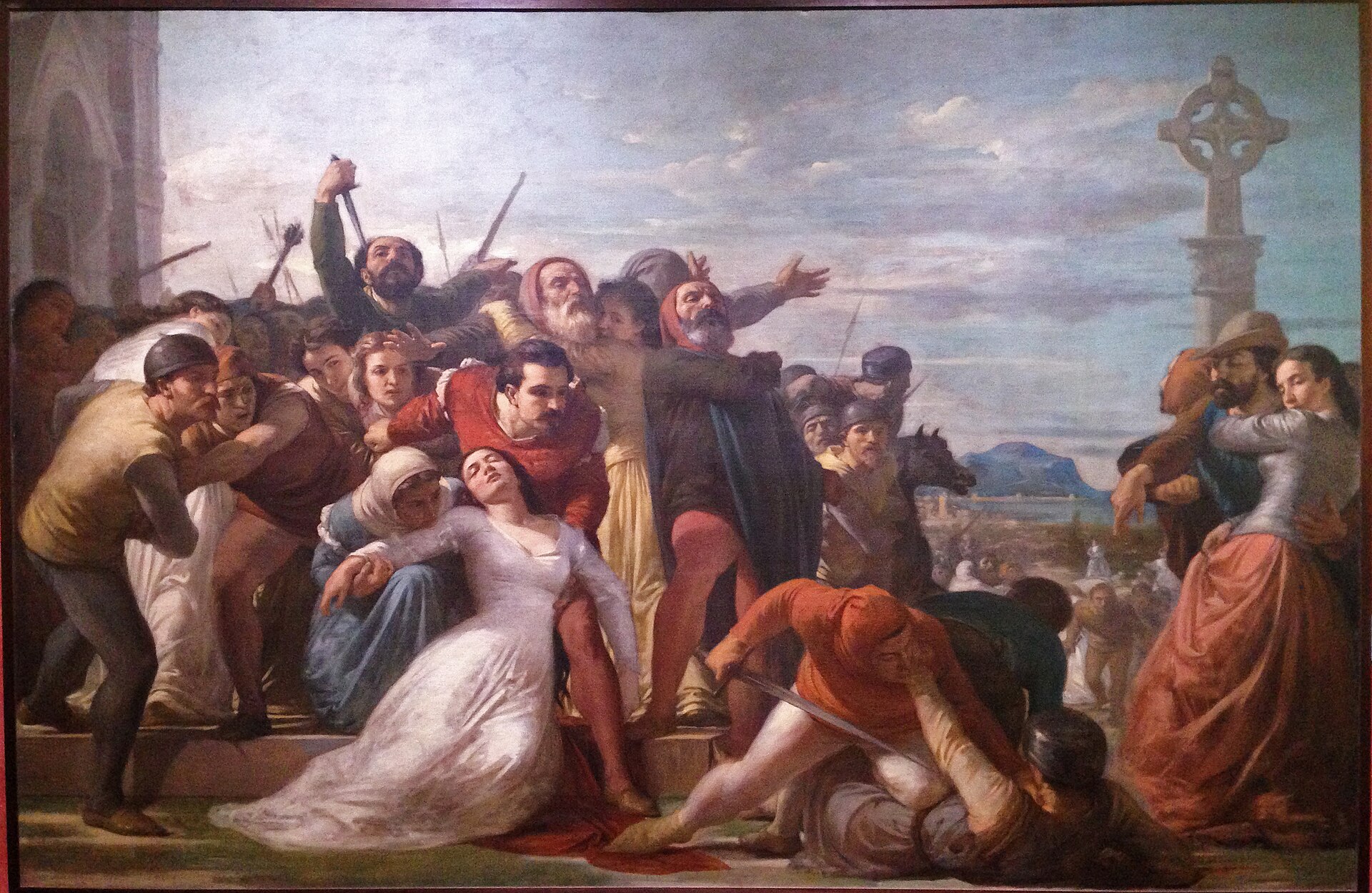
The Sicilian Vespers of 1282 occupy a special place in the island's memory. The Vespers were a great popular uprising, capable of changing the political balance of the Mediterranean. To understand their significance, one must begin with the preceding decades. After the death of Frederick II, the struggles for succession weakened Swabian power. The death of Manfred at Benevento in 1266 and the intervention of Charles I of Anjou opened a new political phase. Sicily thus entered a period of Angevin rule marked by growing tensions. An uprising so vast cannot be explained solely by the episode that sparked it: it was the result of political decisions, social pressure, and balances of power that had matured over time.
Charles of Anjou and taxation
Charles of Anjou governed through a strong military presence and intensified fiscal pressure. The court settled in Naples, while Palermo, which had been the capital in the Arab and Norman periods, lost its direct relationship with the sovereign. The distance was felt in decisions made elsewhere and in the demands that officials and soldiers continued to impose on the island. This is one of the reasons why discontent spread beyond a single class: the barons defended their political space, the cities reacted to the costs of government, and the less affluent inhabitants suffered economic hardship. These motivations were not identical, but they could converge in challenging Angevin rule.
Widespread poverty aggravated social tensions and made the pressure of government heavier. A tax weighs differently on a prosperous community than on one that struggles to sustain itself. When the demands of government increase and trust in those who impose them decreases, any local conflict can take on a broader meaning. It is in this intertwining that the Vespers became an uprising. The word "popular" does not imply that everyone participated for the same reasons or shared a single political project. Between cities, countryside, elites, and less privileged groups, different interests existed. The strength of the revolt also lies in its ability to gather diverse discontents around the challenge to Angevin rule.
A crisis beyond the island
The event did not remain confined within the island's borders. Sicily was a territory coveted for its position and for the value of its cities. A crisis of Angevin government opened space for the intervention of other powers. The Aragonese advance and the Peace of Caltabellotta in 1302 followed the Vespers and contributed to redefining the political order. These dates tell of two different times: the immediate time of the revolt, which erupts and mobilizes, and the long time of wars and agreements that decide how the territory will be governed. Confusing them would make 1282 appear as an instant solution, whereas it marked the beginning of a new phase of confrontation.
Barons and new monuments
The succession of dynasties did not erase the power of the feudal aristocracy. In the subsequent period, the feudal lords actually increased their influence, participating more directly in the island's balance of power. This is one of the most important aspects to consider when speaking of "liberation" from a dominion. The rejection of one government can lead to another form of dependence; a political victory can favor already powerful groups without resolving the problems of the population. The history of the Vespers thus demands distinguishing between the protagonists of the uprising, the new rulers, and the families capable of drawing advantage from the change. Sicily after 1282 was not a society suddenly equal or pacified.
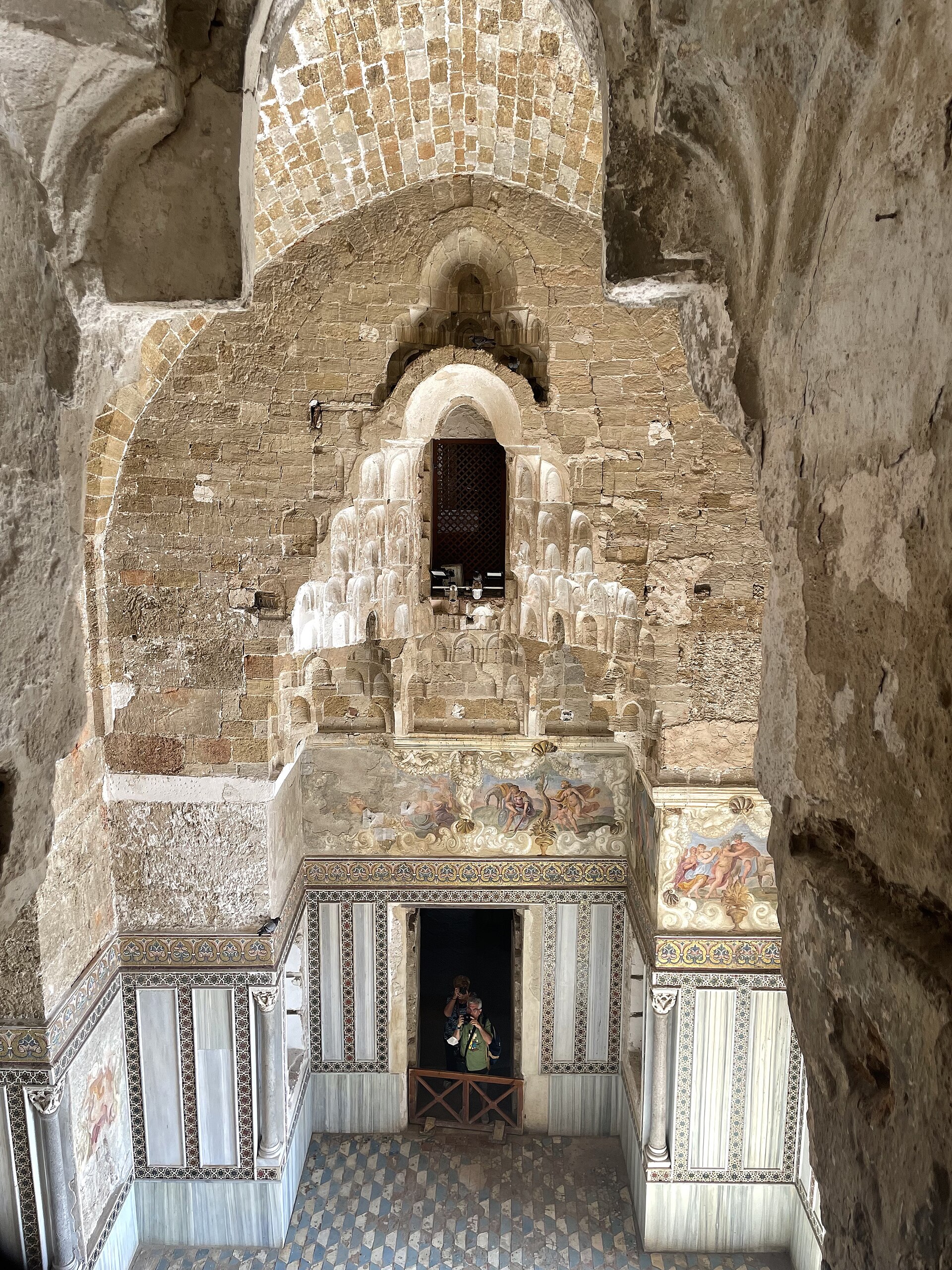
The consequences of political change can also be read in monuments. After the end of the Swabian era, baronial palaces and castles gained greater prominence. The so-called Chiaramonte period was linked to the role of great families and of craftsmen from other Italian regions. The Palazzo dello Steri in Palermo, symbol of the power of the Chiaramonte, helps visualize this phase. An aristocratic building tells of an authority different from that expressed by a great royal court: it brings to the fore the prestige and capacity for action of a family. For this reason too, architecture can be read as a source of political history.
The memory of the Vespers
The memory of the Vespers then took on a life of its own. A scene of the revolt preserved in the Galleria d'Arte Moderna in Palermo shows how the Vespers also became an artistic subject. A painting created many centuries after the event does not directly document what happened in 1282; rather, it tells how a later era chose to represent it. Figures, gestures, and composition transform the revolt into a public image. This passage from chronicle to memory deserves attention, because communities often recognize in a historical episode a symbol of their own identity. Looking at a work about the Vespers therefore means asking two questions: what do we know about the revolt, and why was it remembered in that way?
The Peace of Caltabellotta in 1302 shows how long the effects of the Vespers lasted: twenty years after the uprising, the powers involved were still seeking a recognized order. The agreement tied the government of the island to the Aragonese dynasty and left the political destinies of Sicily and the mainland kingdom separate. Palermo remained the symbolic place of the revolt and of the loss of centrality that had preceded it; Caltabellotta gave its name to a diplomatic compromise. Relating the two places helps distinguish the popular beginning of a crisis from the way sovereigns attempted to close it. Neither moment alone exhausts the history of 1282.
The Sicilian Vespers were therefore at once social protest, dynastic crisis, and geopolitical turning point. Their story does not end with the initial act of rebellion. It encompasses the conditions that preceded it, the alliances that changed its outcome, the strengthening of certain feudal families, and the memory constructed in the following centuries. It is precisely this stratification that makes them a subject still useful for reading the island's history. Remembering 1282 means observing how a discontent that matured in Sicily could redesign much vaster power relations, without eliminating all the inequalities that had fueled it.
Photo: Davide Mauro · CC BY-SA 4.0 · Wikimedia Commons