
 EN
EN Italiano
 Français
 Deutsch
 Polski
 Nederlands
 Español
 日本語
日本語 Čeština
 简体中文
简体中文 Русский
 Português
 한국어
한국어 Magyar
 Norsk
Norsk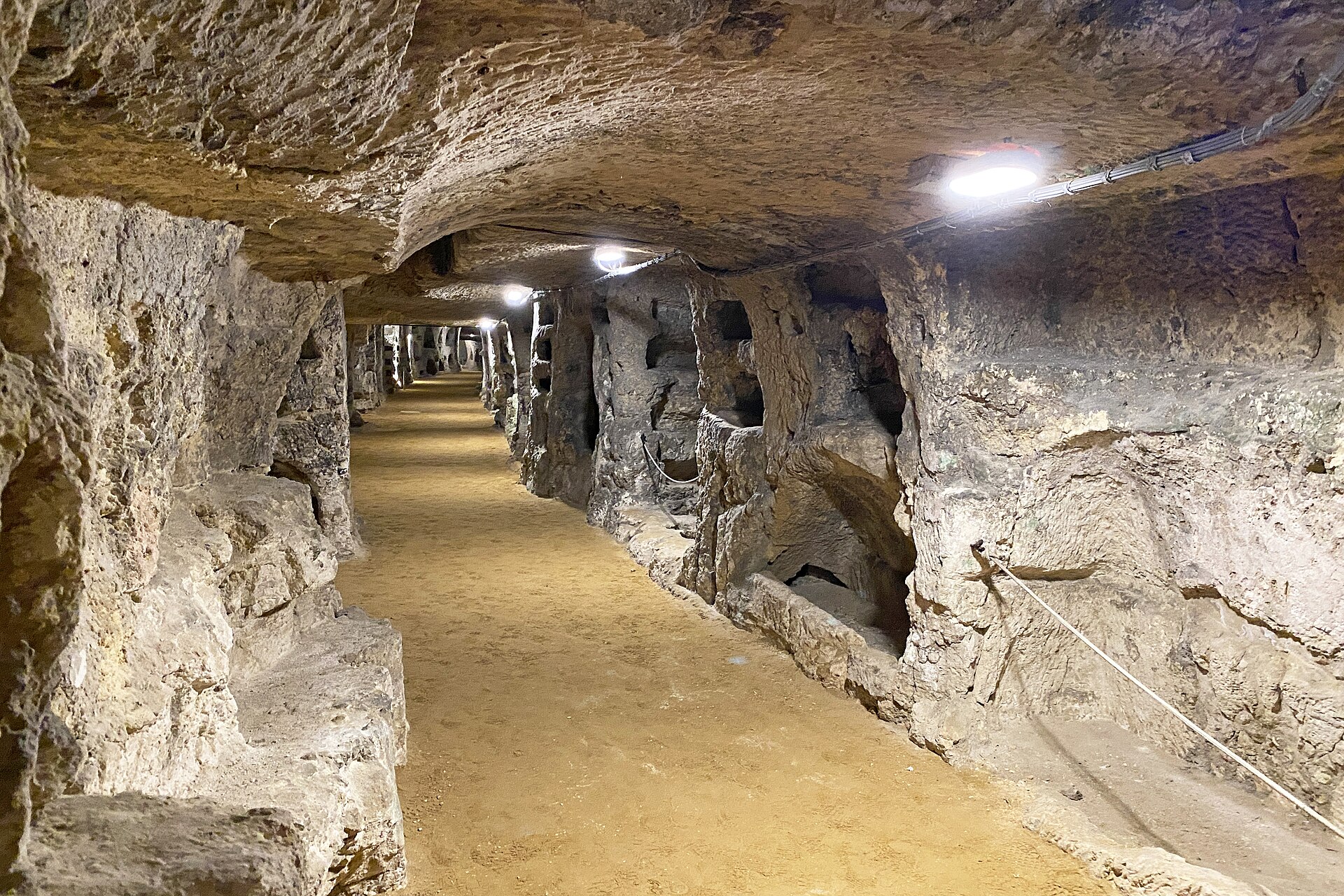
Christianity spread in Sicily while the cities still preserved the institutions, buildings, and traditions of the Roman world. The earliest recognizable traces are linked above all to communities and burials; the great visible churches came later. The difference matters: a religion can be practiced for generations before it visibly alters the profile of a city. Even when new places of worship appeared, the earlier ones did not disappear everywhere at the same moment. The history of Sicilian Christianity must therefore be traced through tombs, memories of martyrs, reused spaces, and basilicas, keeping distinct the eras to which they belong.
The first burials and the martyrs
Around 200 AD the first Christian burials appear; Saint Marcian of Syracuse and Saint Agatha of Catania are among the earliest names in Sicilian Christian memory. The traditions about the martyrs belong to a religious and civic history that took shape over time. The later feasts and dedications show how important those figures became for the cities, but they do not by themselves document every detail of their lives. For anyone observing an archaeological site, the most concrete point is the appearance of places where a community laid to rest and remembered its dead. Tombs are not merely chronological clues. They tell of the way beliefs, affections, and collective identities sought a recognizable space within the urban fabric and the territory.
From Constantine’s edict to the communities
The edict of Constantine in 313 marked a decisive passage toward freedom of worship. From that moment Christian communities could organize their presence in more visible forms. Religious architecture, however, did not all emerge at once, nor according to a single model. Some pre-existing spaces were reused; elsewhere new buildings were constructed. The first churches could rise near older structures; from the 5th century churches and basilicas appeared with floor plans designed for Christian worship. Sicilian places of worship should therefore be observed as buildings that grew through successive phases.
Syracuse and Catania hold an important place in this account because of the figures of Marcian and Agatha, but the spread of Christianity concerns the entire island. Communities moved within cities already equipped with streets, neighborhoods, necropolises, and public spaces. Changing the use of a space also meant changing the way it was traversed and assigned value. A tomb could become a destination of memory; a building adapted for worship could acquire a new symbolic center. These are transformations only partly legible in the stones that remain. For this reason, the comparison of archaeology, chronicles, and local traditions requires care.
Tombs and churches from late antiquity to Byzantium
The latomie of Palazzolo Acreide offer a concrete example of stratification, with tombs attributed to the Byzantine and Christian period. The same image unites a cavity linked to earlier phases and a later use as a funerary place. This kind of reuse is a valuable key to understanding the historical landscape of Sicily. A site does not necessarily belong to a single era. Communities can recognize in an existing space a new usefulness or meaning, without completely erasing the earlier forms. Reading a carved rock or a modified wall therefore requires distinguishing the different moments of its life.
In late antiquity and the Byzantine age, religious life became increasingly intertwined with the political organization of the island. The passage under the power of Constantinople and the ecclesiastical properties connected to Gregory the Great show how deeply religious life was interwoven with institutions. These references show that Christianity was not only about individual prayer. Churches and religious institutions could manage property, shape the life of communities, and maintain relations with distant authorities. At the same time, local traditions gave places a specific memory. The Christian history of Sicily is therefore also a history of territories, properties, and relations between different centers.
How to read the earliest Christian traces
To observe the earliest Christian testimonies, it is useful to avoid two shortcuts. The first is to consider every ancient building as having remained identical to the moment of its foundation: many churches were enlarged, decorated, and sometimes rebuilt. The second is to seek a clear replacement of one cult by another in every single place. Reused structures and overlapping artistic languages in monuments show how this process took shape in the territory. A nave, a tomb, a decorative fragment, or the plan of a basilica may belong to different phases. Asking when they were made and how they were used makes a visit more interesting than the quick identification of a style.
The Christianity of the early centuries is thus recognizable in minute traces and in great transformations. The burials, the memories of the martyrs, the opening that followed the edict of Constantine, the birth of churches and basilicas, and the subsequent Byzantine period form a long sequence. The crypt of Saint Marcian and the ancient cathedral of Syracuse are useful places for following this history; observing them requires attention to the different construction phases. Sicily did not cease to be Mediterranean while it changed religion: it continued to receive people, ideas, and artistic forms from different areas. Anyone visiting Syracuse, Catania, or Palazzolo Acreide can look for the signs of this continuity in museum collections and places of worship. Reading those signs means holding together faith, archaeology, and the history of the city.
Photo: Bernard Gagnon · CC BY 4.0 · Wikimedia Commons





























_01.jpg)