EN
EN Italiano
 Français
 Deutsch
 Polski
 Nederlands
 Español
 日本語
日本語 Čeština
 简体中文
简体中文 Русский
 Português
 한국어
한국어 Magyar
 Norsk
Norsk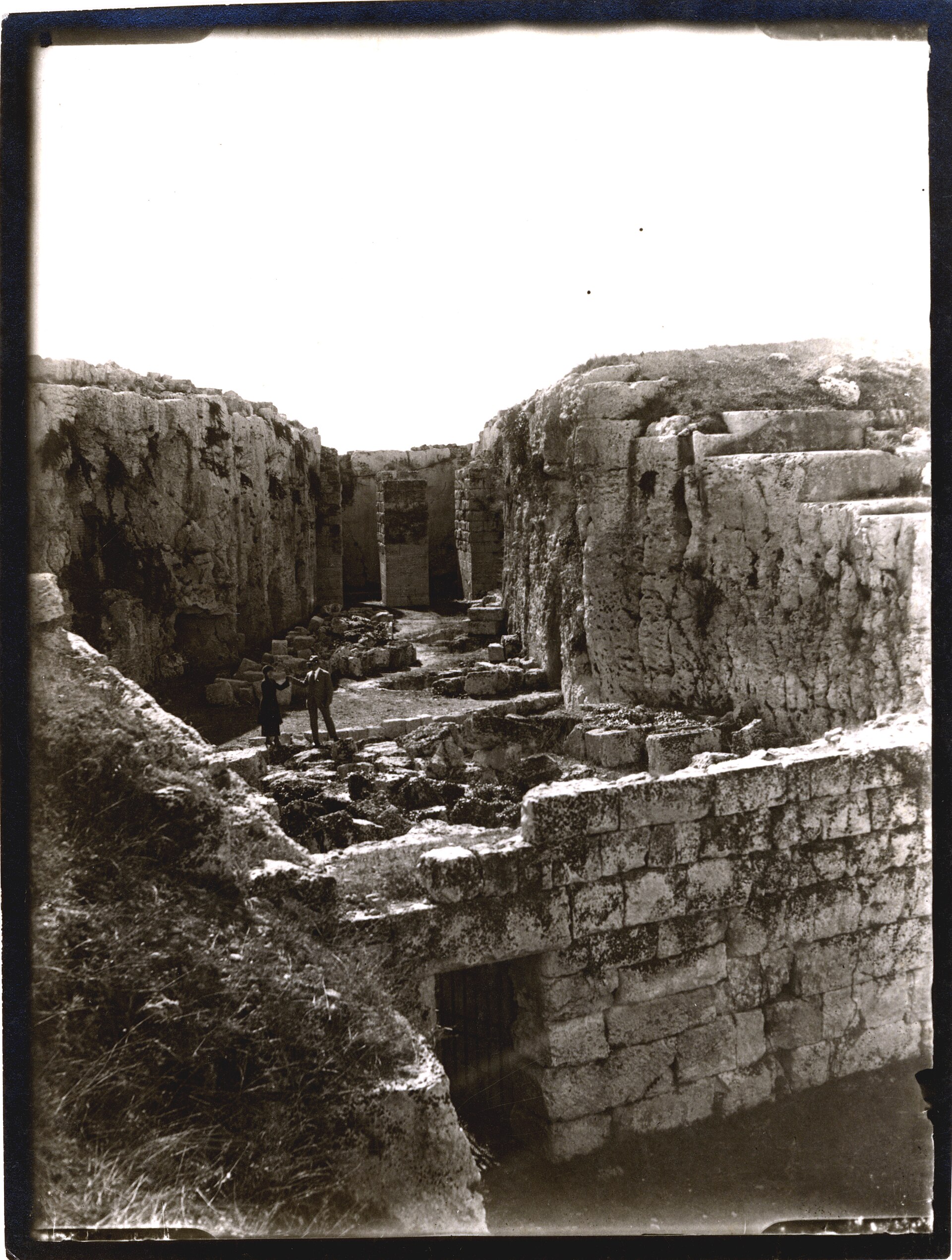
Syracuse was one of the richest and most powerful cities of the Greek West. Its position and its resources attracted the attention of Athens and set it in competition with Carthage. It was in this city, already tried by wars and political tensions, that Dionysius the Elder rose to power. His long rule is linked to military campaigns, the strengthening of defenses, and the subjugation of other Sicilian cities. To understand how he was able to impose himself, one must start from the climate of danger: when defense appeared urgent, a commander capable of controlling armed men could concentrate an authority that ordinary institutions would not have granted him.
Athens and Carthage against Syracuse
The Athenian expedition begun in 415 BC had already shown how much Syracuse counted in the balances of the Greek Mediterranean. The siege ended with the defeat of the Athenians: the city had withstood a distant power, mobilizing resources and allies. The victory, however, did not put an end to the Sicilian wars. Competition with Carthage and rivalries among Greek cities remained. In this context, the Syracusan harbor, maritime connections, and the ability to raise troops were decisive resources. Dionysius thus inherited a prestigious but exposed city: his policy of fortification and expansion responded to this situation and, at the same time, allowed him to consolidate his own dominion.
Carthage also sought to assert its weight on the island. Threats and military campaigns preceded Dionysius's dominion and prepared a phase of strong concentration of power. Military pressure was one of the factors that favored his rise: he imposed himself with the support of an armed force of mercenaries and took control of Syracuse at the beginning of the fourth century BC. The presence of soldiers bound directly to the commander clarifies an essential difference from the ordinary functioning of a city governed by its institutions. Dionysius could act with rapidity and impose decisions, but his authority also depended on the force he was able to maintain.
Dionysius’s conquests and walls
Dionysius was a skilled strategist and conducted campaigns with which he subjugated much of the island. The growth of his power did not consist of a single victory. It required control of cities, the ability to respond to new threats, and the construction of a political network useful to Syracuse. Expansion had concrete effects on the communities involved: alliances, military priorities, and margins of autonomy changed. For the inhabitants of the capital, greater security could coexist with tighter control of political life. For subordinate centers, Syracusan power was a factor on which many choices depended.
The fortifications are one of the most evident signs of that era. Dionysius strengthened the defenses of Syracuse, because victories had not erased the risk of new attacks. The walls were not simply a technical work. They expressed the will to protect a city, to organize the resources necessary for the works, and to show adversaries that a siege would be costly. It was necessary to garrison the approaches, maintain the defenses, and secure supplies: a defensive system engaged men and money even far from battles. In the case of Dionysius, the defense of the capital was inseparable from the project of making it the dominant center of Greek Sicily.
War and the verdict on Dionysius
The war with Carthage resumed and dragged on for a long time. The hostilities begun at the end of the fifth century BC accompanied much of Dionysius's political career. The confrontation with a power present on the other shore of the Mediterranean shows once again why Sicily was strategic. It was not only a question of land borders: control of landing places and routes counted as much as that of cities. Military campaigns could bring prestige to the ruler, but they required men, money, and sacrifices. The long duration of the conflict helps to explain how the theme of security remained at the center of Syracusan government.
The judgment on Dionysius remained ambivalent. His government was harsh, but Syracuse also experienced a phase of great power and development. To read this formula, one must separate the different levels of the account. A city can be powerful and produce remarkable works even when power is exercised in an authoritarian manner. Military efficiency does not answer the question about citizen participation; the grandeur of constructions does not reveal how the costs of enterprises were distributed. Dionysius was decisive for the history of Syracuse, but the importance of his government does not oblige one to transform him into a hero without contradictions.
After Dionysius
After his death, the contrasts between Dionysius II and Dion emerged. The city weakened and feared a new Carthaginian advantage; the intervention of Timoleon, sent by Corinth, opened another phase. The succession shows a frequent limit of personal powers: what a leader holds together can become fragile when he disappears. The subsequent events of Agathocles confirm that the struggle for control of the island did not end with Dionysius. Wars, personal ambitions, and difficult relations with Carthage returned. For those who visit Syracuse, the Greek theater, the Fountain of Arethusa, and the traces of the city's defenses are starting points for imagining that era. None of them tells of Dionysius alone. Together, however, they show a polis in which culture, war, and power coexisted and mutually conditioned one another.
Photo: Luigi Maria Ugolini · CC BY-SA 4.0 · Wikimedia Commons