EN
 Italiano
 Français
 Deutsch
 Polski
 Nederlands
 Español
 日本語
 Čeština
 简体中文
 Русский
 Português
 한국어
 Magyar
 Norsk
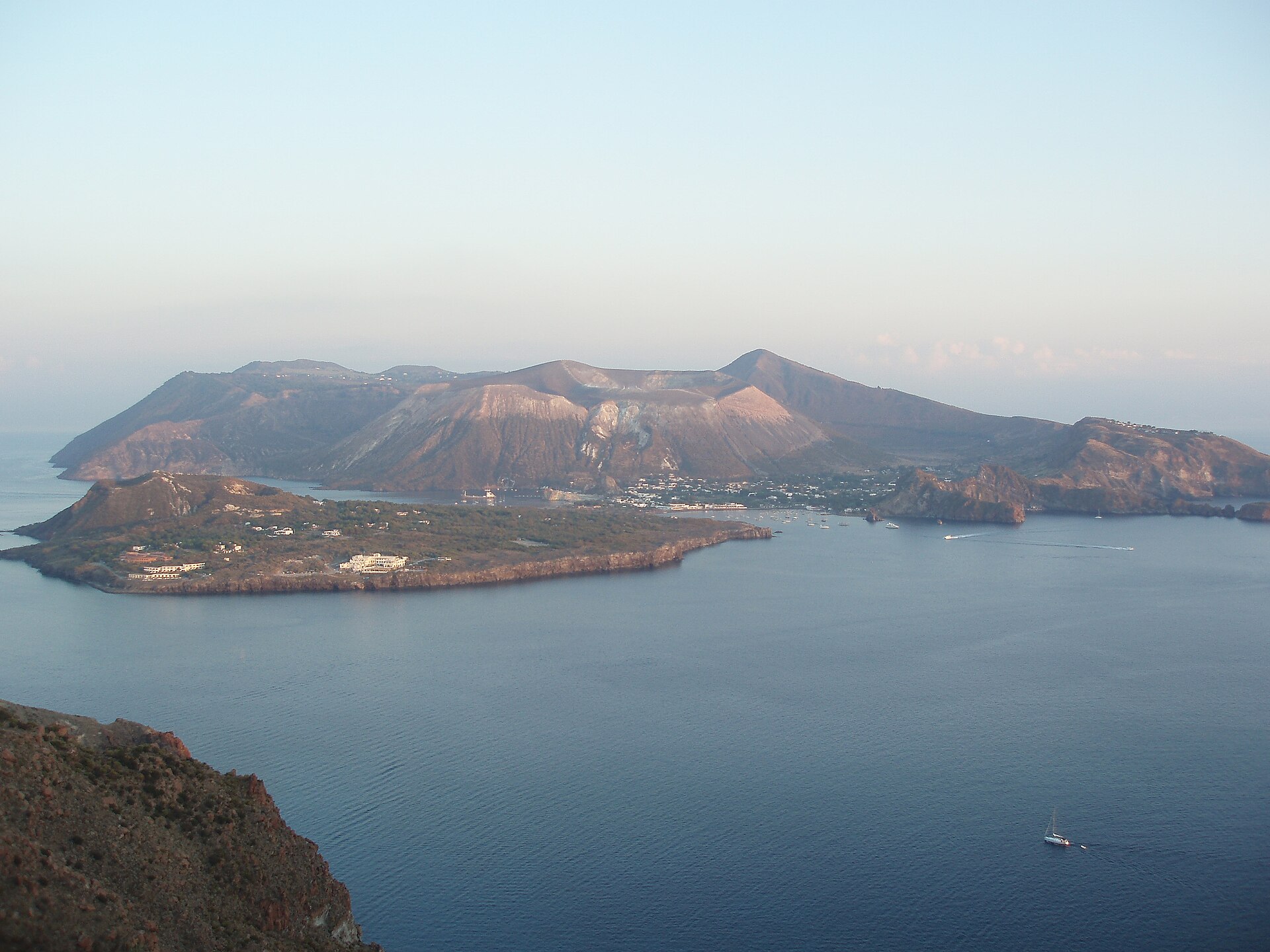
The Aeolian Islands can be read as an archipelago of sister islands, yet each has a recognizable profile. Their volcanic origin invites us to observe how the Earth's activity has produced different coastlines, reliefs, cliffs, and seabeds. The sea unites them and at the same time separates their characters. For this reason, a journey among the Aeolian Islands becomes richer if it does not seek only beaches and crossings: every landing is an opportunity to understand a form of the landscape. Looking at a cone, a rocky wall, or a trail of dark stone means reading a stage in the geological history of the archipelago, without reducing the islands to a single postcard image.
Lipari
Lipari, the largest of the islands, offers a good starting point. Monte Guardia, Forgia Vecchia, and Rocche Rosse are landmarks for observing volcanic forms and materials. Even without turning the visit into a geology lesson, the differences in color and consistency of the rocks invite us to wonder how they were formed. The coastal landscape places the walls in relation to the sea, while the interior reveals slopes and ancient surfaces. Moving among these places makes it clear why the Aeolian Islands have attracted not only travelers but also scholars interested in recognizing in the rock the memory of eruptions and subsequent transformations.
Vulcano and Stromboli
Vulcano is perhaps the island that most immediately expresses the idea of a territory born of fire. On the island, several volcanic systems can be distinguished, including Vulcanello, connected to the rest of the island through materials deposited over time. The shape of the terrain thus tells a story of emergence, accumulation, and change. The fumaroles and thermal phenomena, where present and observable according to current regulations, remind us that a volcanic landscape is not merely ancient. It is important to observe it with respect, from permitted areas, because gases, heat, and instability can make a place different from how it appears in a photograph. The visitor's interest lies in understanding the relationship between natural processes and habitable surface.
Stromboli has an identity that is different still. The Sciara del Fuoco is the great slope along which volcanic materials reach the sea; the Vancori adds another relief to the island's profile. From a distance, the island's outline seems simple; as you draw closer, slopes and areas with uneven vegetation become distinguishable. The Sciara makes visible the connection between summit and coast, between what happens at altitude and what modifies the shoreline. To describe it means avoiding the pursuit of spectacle at all costs: the island is also an inhabited environment, with daily rhythms and natural conditions to be followed with attention. The observations possible change over time, so the experience must be built on updated local information.
Panarea and Filicudi
Panarea introduces another scale. Around the island are Basiluzzo, Spinazzola, Lisca Bianca, Dattilo, Bottaro, Lisca Nera, the Panarelli, and the Formiche. This constellation of islets and rocks invites us to see the archipelago within the archipelago. The relatively shallow sea in some areas and the presence of phenomena such as submerged springs and fumaroles help us understand that the volcanic story does not stop at the water's edge. The emerged outlines are only the visible part of a larger relief. From a boat or a panoramic viewpoint, recognizing the names of the rocks and comparing their shapes makes that stretch of sea less uniform and more legible.
Filicudi, by contrast, is described through reliefs such as Fossa Felci, la Montagnola, and il Torrione, as well as Capo Graziano. Its shape, observed from a distance, changes as you move along the coast. An excursion that alternates between the water's edge and the higher elevations shows how vegetation has adapted to the slopes and exposure. Alicudi, the westernmost of the major islands, appears from afar as an essential cone. Its image invites slowness: the absence of large plains makes evident the relationship between slope, settlement, and paths. Filicudi and Alicudi remind us that the same volcanic origin can give rise to very different travel experiences.
Salina and the seven sisters
Salina adds the power of a vegetated landscape. The Monte delle Felci and dei Porri reserve encompasses the reliefs born of ancient craters. Along the climb toward Monte delle Felci, one encounters environments that change with altitude; in the cooler zones, chestnut woods are also reported. A path rises from Valdichiesa toward the summit and can continue in the direction of Santa Marina, but times and passability must be assessed on site. Near Pollara, the coastal walls also hold faunal value: they can host Eleonora's falcon, which uses certain rocky stretches of the archipelago. Here, observation from a distance protects both the visitor and the animals.
The seven major islands show different outcomes of the same geological origin. Lipari allows us to compare rocks and reliefs; on Vulcano, phenomena linked to the heat of the subsoil are still perceptible; the Sciara del Fuoco distinguishes Stromboli's profile. Panarea is understood by also looking at the constellation of its islets, while on Salina the path leads from the settlements to the green slopes of ancient craters. Filicudi and Alicudi make the relationship between slope, coast, and settlements more evident. This variety gives a criterion to the journey: observe a form of the terrain on one island and look for how it changes on the next. The sea connects the stages, but it is the comparison between their landscapes that truly makes the archipelago understood.
Photo: t_y_l · CC BY-SA 2.0 · Wikimedia Commons