EN
EN Deutsch
 Français
 Italiano
 Polski
 Nederlands
 Español
 日本語
日本語 Čeština
 简体中文
简体中文 Русский
 Português
 한국어
한국어 Magyar
 Norsk
Norsk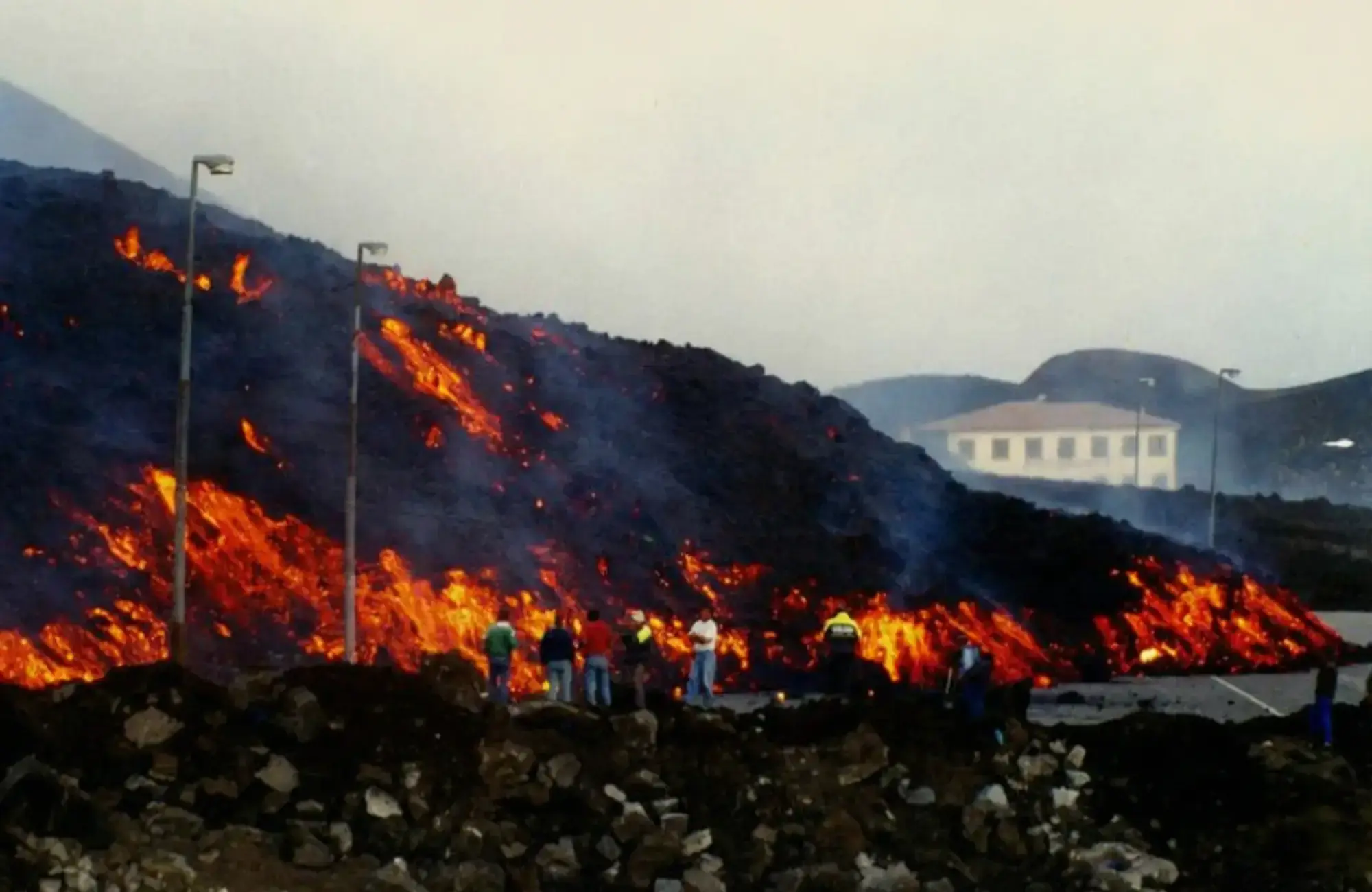
There is a date carved into the memory of every Sicilian, and particularly those who live on the slopes of Europe's highest active volcano. That date is the Oct. 27, 2002. Indeed, it was no ordinary day and, as a result, what began that night was not just a routine activity. On the contrary, we are talking about the 2002 Etna Eruption, an event so powerful that, for this reason, it has been dubbed by scholars as the "perfect eruption."
If you visit the northern slope of Etna today, at Piano Provenzana, you will be walking over meters of solidified history. Under your feet, buried by black rock, are memories, hotels, roads and dreams. In this article I will take you back in time, tracing the dramatic moments of those days and guiding you to discover what remains today of that extraordinary event.
The beginning of the nightmare: The night the mountain split apart
It all began in the middle of the night between October 26 and 27. Etna did not give much warning. There were no weeks of light "rumblings." L' Etna eruption 2002 came with the violence of an earthquake.
An intense seismic swarm shook the piedmont towns. Houses were shaking in Linguaglossa, Zafferana Etnea, and Santa Venerina. But it was not only the earth that was shaking; it was the very structure of the volcano that was yielding to internal pressure. The magma, rising with impressive speed, fractured the volcanic edifice from north to south.
Imagine the scene: in the pitch blackness, the sky suddenly lit up red. Not from a single point, but from a long line of fire. What volcanologists call a "button fracture" had formed.
What is a button fracture?
To understand the dynamics of theEtna eruption 2002, one must visualize a shirt tearing along the buttons. The earth's crust literally opened into two opposite sides:
- South slope: A fracture opened above Rifugio Sapienza, reaching up to an altitude of 2700 meters.
- North slope: The most dangerous fracture, the one that started from the summit and descended very fast to an altitude of 1900 meters, pointing straight toward the tourist resort of Piano Provenzana.
It was the beginning of the end for the "Cortina del Sud," as the North Slope ski resort was then called.
Historical note: The seismic activity was so violent that hundreds of tremors were recorded in a few hours, causing extensive damage even to homes in downstream villages, particularly Santa Venerina
The Drama of Piano Provenzana: Lava erases everything
On the morning of October 27, the situation on the North Slope precipitated drastically. Lava flows, fed by the eruptive vents that had just opened along the fracture, descended swiftly through the pine forest.
Unlike the southern slope, which is more barren, the northern slope has a wonderful forest of centuries-old Larch Pines (the Ragabo Pine Forest). Seeing the fire advancing through the green trees was a terrifying sight.
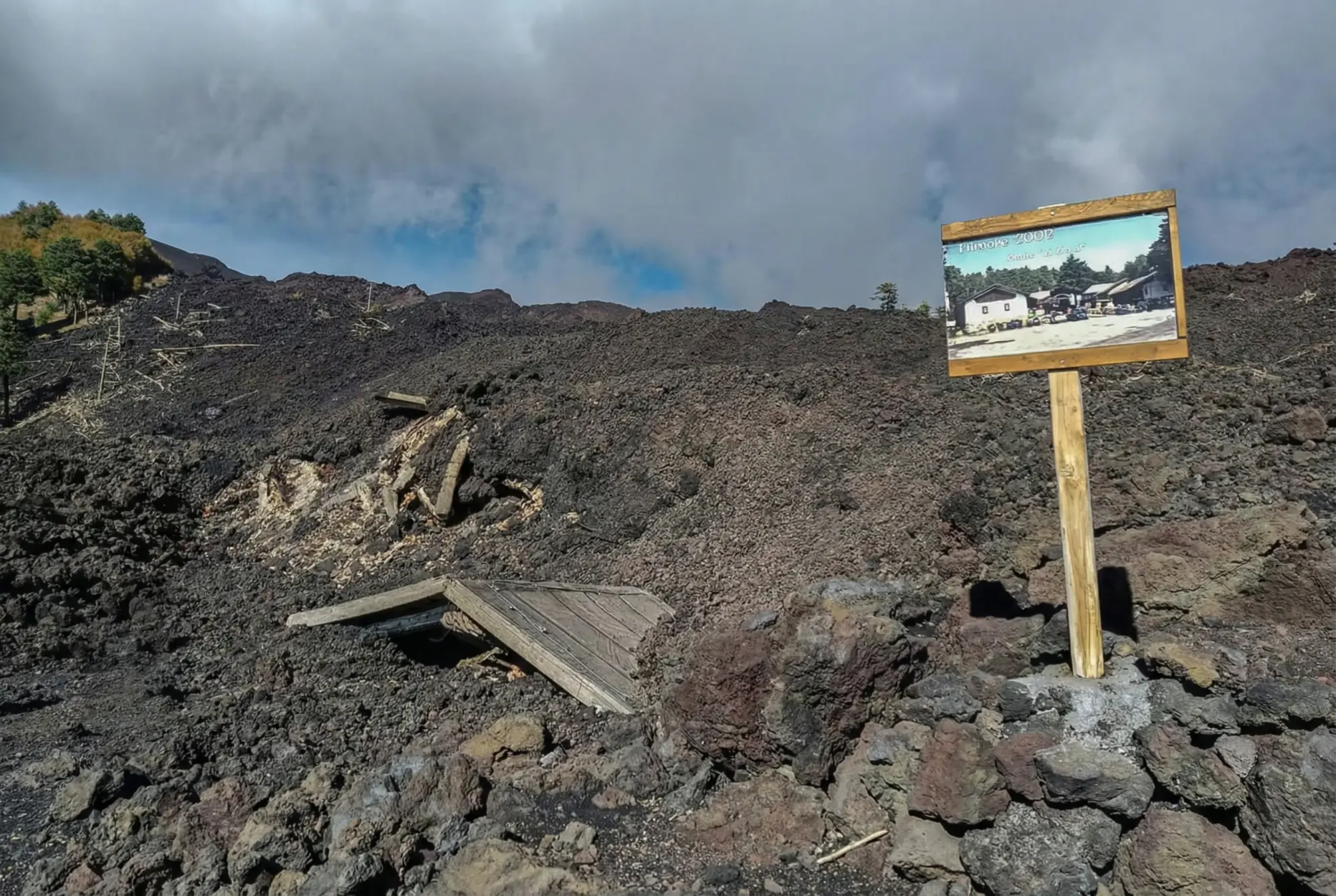
The lava from theEtna eruption 2002 had no mercy. It pointed straight toward the square of Piano Provenzana. There were historic hotels such as Hotel Le Betulle, souvenir stores, ski schools, and the ski lift departure station.
The race against time
The testimonies of those who were there are chilling. Tour operators, guides and facility owners desperately tried to salvage what could be saved. They loaded onto trucks skis, boots, computers, logbooks, everything that could be wrested from the volcano's fury.
But the lava was too fast. Within hours, the lava front reached the buildings.
The first to fall was the ski school building. Then, the glowing mass surrounded the Hotel Le Betulle. The images broadcast on the news went around the world: a multi-story building crumpling in on itself, pushed and melted by the heat, before being completely engulfed and buried.
Of Piano Provenzana, nothing remained that night. Only a smoldering expanse of black stone. The tourist economy of an entire slope was wiped out in less than 24 hours.
The South Slope and the black rain over Catania
Meanwhile, while hotels collapsed in the north, in the south the eruption showed another face. Specifically, that of explosions. The vents to the south were not only making lava, but also lots of ash. As a result, a black "mushroom" formed that obscured the sun.
The city covered in ash
For days and weeks, Catania and neighboring towns lived in an apocalyptic atmosphere. Ash fell incessantly, like black snow.
- Fontanarossa airport was closed for weeks (a negative historical record).
- The roads became impassable and slippery.
- The roofs of houses were in danger of collapsing under the weight of the accumulated volcanic material.
- People walked around with open umbrellas not for the rain, but to protect themselves from the black sand.
L'Etna Eruption 2002 made it clear how precarious life at the foot of the volcano is and tied to the moods of the mountains. It was an event that brought the economy of half of Sicily to its knees, not just the tourist economy
Why is the 2002 Eruption referred to as "The Perfect Eruption"?
From a scientific point of view, theEtna eruption 2002 is considered an exceptional case study, often referred to as the "perfect eruption." But why?
It is not often that a mixed (effusive and explosive) eruption is observed to occur simultaneously on two opposite slopes, triggered by such a sharp fracturing of the volcanic edifice. INGV (National Institute of Geophysics and Volcanology) geologists monitored the event minute by minute, gathering valuable data on the dynamics of Etna's magmas.
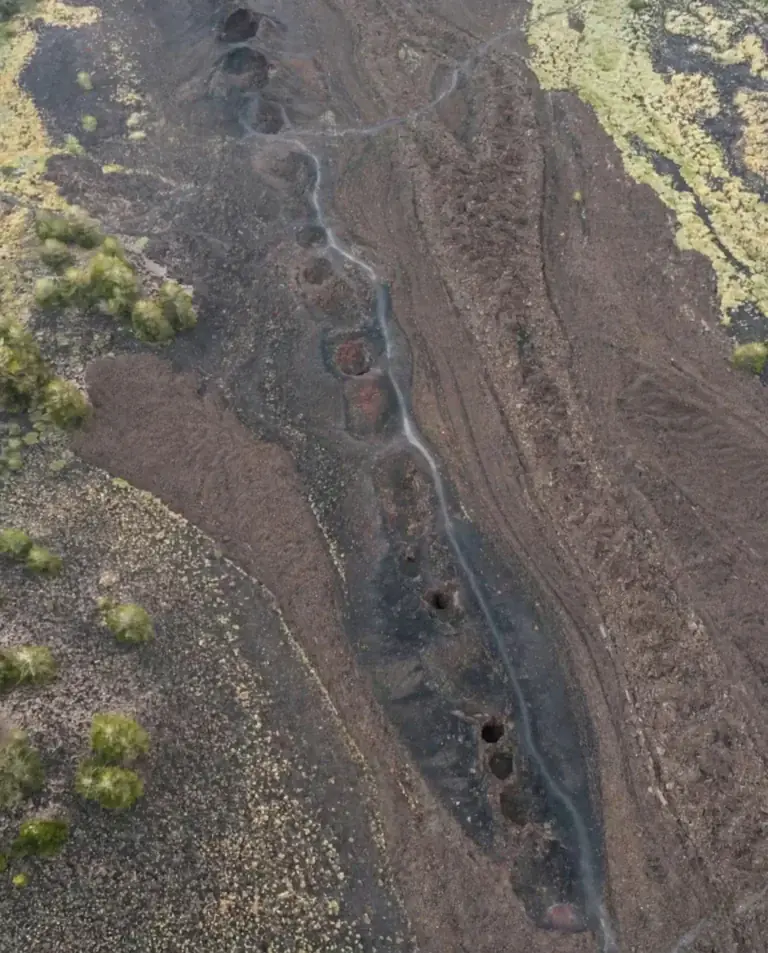
It was discovered that the magma was very rich in gas, which explained the extreme explosiveness and rapid formation of the slag cones. Moreover, the shape of the cones that were created along the North Slope fracture is textbook geology: a series of perfectly aligned craters, now known as Buttonhole from 2002.
Visiting the sites of the Eruption today: A trek through history
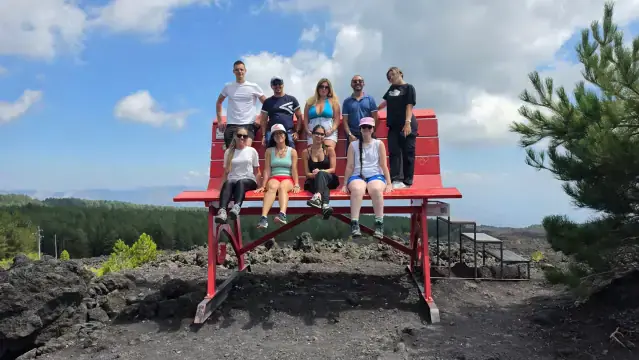
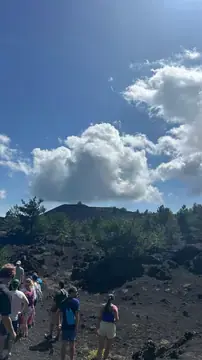
Today, more than two decades later, the area affected by the2002 Etna eruption is one of the most fascinating destinations for hikers. Nature, with its slow but inexorable pace, is beginning to regain its space, but the scars are still evident and spectacular.
If you want to experience firsthand the power of that event, you should definitely plan a hike on the northern slope, starting right from the "new" Piano Provenzana (rebuilt further downstream than the previous one).
The route to the Button House
Here is how the hike to see the 2002 craters typically unfolds:
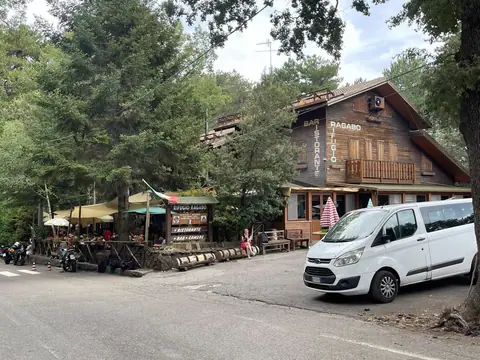
- Departure: You leave your car at the Piano Provenzana parking lot (elevation 1800 m). Here you can see the new wooden structures, built to be dismantled if needed-a lesson learned the hard way.
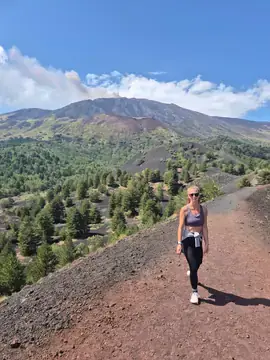
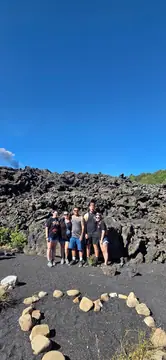
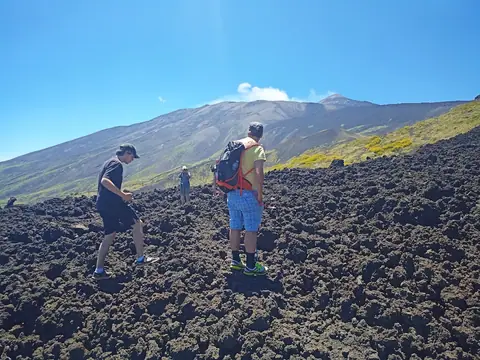
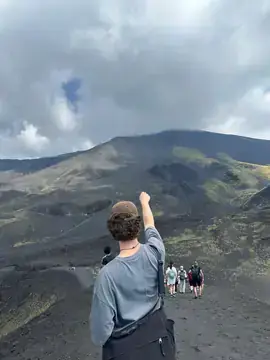
- The Ascent: You walk along the dirt road up the ski slopes. From the very first steps, you will notice the color contrast. On one side the bright green of the surviving pines, on the other the absolute, angular black of the 2002 flow.
- Black Mountain: Climbing toward an altitude of 2000-2100 meters, one encounters Mt. Nero, an ancient volcanic cone.
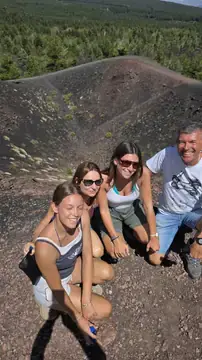
- The arrival at the Craters: And there it is, the Buttonhole. A series of volcanic cones lined up like pearls on a necklace. The rock here has incredible hues: deep red (due to iron oxidation), yellow (sulfur) and black.
The view: From up here, looking toward the sea, one can clearly see the "river" of stone that poured downstream. It is a picture that takes one's breath away and makes one understand the scale of the disaster narrowly avoided by the towns of Linguaglossa and Castiglione di Sicilia.
The Petrified Logs

Along the way, sharpen your eyesight. You may come across strange shapes in the lava rock. These are the so-called "casts" or "lava logs."
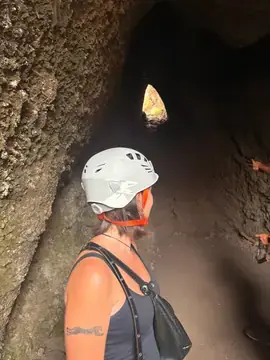
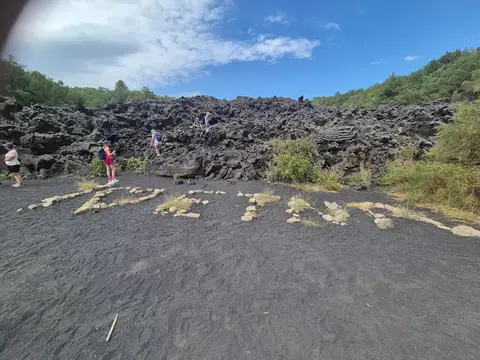
During the 2002 Etna Eruption, fluid lava enveloped large pine trees. The extremely high temperature instantly burned the wood, but the rock solidified so quickly around the trunk that it retained its hollow shape inside. They are the ghosts of the forest that is no more, eternal witnesses of that October night.
Rebirth: Nature and man begin again
Despite the devastation, the story of theEtna eruption 2002 Is not a sad story. It is a story of resilience.
A few years after the eruption, locals rolled up their sleeves. Piano Provenzana has been rebuilt. The ski lifts are back in operation. In winter, people ski again while looking at the sea, an experience unique in the world.
And nature is also taking its course. On the barren black lava of 2002, the first clumps of Stereocaulon vesuvianum (a silvery gray lichen that prepares the ground for other plants) and Etna's first gorse. In a few decades, that black flow will be a green forest again. It is the eternal cycle of the volcano: destruction and creation.
Practical tips for your hike
To best experience the excursion to the sites of theEtna eruption 2002, here are some basic suggestions for your safety and enjoyment:
- Clothing: Even if it is summer, always bring a windbreaker. At an altitude of 2,000 meters, the weather changes rapidly. Wear high hiking boots: volcanic sand gets in everywhere and lava rock is sharp as glass.
- Water and food: There are no refreshment stations along the trail to the Buttonhole. Bring at least 1.5 liters of water.
- Volcanological Guides: Although the low path is doable on your own, to climb to the edges of the craters and really understand the geology of what you are seeing, I strongly recommend that you book a hike with a licensed volcanological guide. They will enrich your experience with anecdotes and technical details that no paper guidebook can give you.
Useful links: Before leaving, always check the volcano alert status on the website of theINGV Catania (National Institute of Geophysics and Volcanology).
Etna today
L'Etna Eruption 2002 teaches us that we are not the masters of the Earth, but only guests. Visiting these places is not just trekking; it is walking inside a page of geological history that is still fresh.
Hearing the crunching of lapilli under your boots, touching rough rock that until a few years ago was 1,000-degree liquid magma, looking at the white skeletons of burned trees silhouetted against the blue sky-all of this is an experience that will change you.
Etna is beautiful when it is calm, but it is sublime when it reminds us of its power. And the craters of 2002 are there, majestic and silent, reminding us every day.
Do you want to discover the sites of the 2002 Etna Eruption live?
Don't just read about it. Plan your visit to Etna. Check out our section on[Etna North Excursions] to find the best routes and the most experienced guides. Do you have questions or personal memories of those days? Leave a comment below, we will be happy to read your story.